Goofy
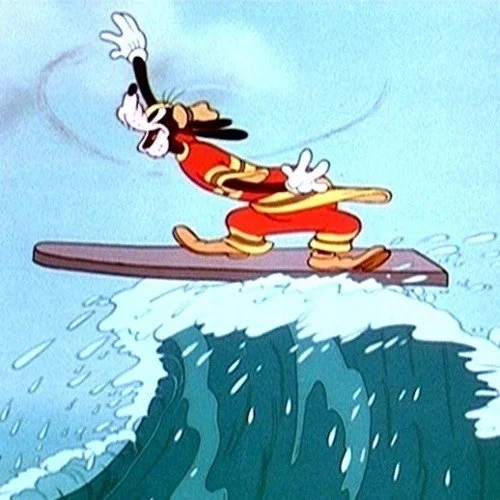
This winter I found myself at the top of Shawnee Mountain in Pennsylvania, settling into that easy, sun‑warmed rhythm of après ski. I had a beer in hand and was chatting with a couple of people I’d just met at the bar. It was the kind of conversation that feels effortless simply because everyone is still buzzing from the run they just finished. At some point, we bonded over the fact that two of us were both "goofy". No, not in personality (although that was also probably true), but in the way we road down the mountain: goofy riders have their right foot forward which is the less common stance for most snowboarders.
As we talked, they told me where the term actually came from: an old Disney cartoon in which Goofy surfs with his right foot forward. One animated moment from nearly a century ago ended up naming an entire stance across surfing, skateboarding, and eventually snowboarding. It’s funny, but it’s also a reminder of how much our language and our sense of what’s normal is shaped by what we’ve seen before. A single image can legitimize something that might otherwise feel unusual. It gives people a reference point, a way to say, “This is real. This is allowed. This is mine.”
It is similar to the rise of left-handedness. For generations, left‑handed children were corrected, discouraged, or outright forced to switch hands. Once schools stopped doing that and parents stopped worrying, the number of people identifying as left‑handed rose dramatically. The biology didn’t change, but the permission did and when people are allowed to show up as themselves, the data shifts.
Representation isn’t just symbolic, it shapes behavior, confidence, identity, and the quiet choices people make about how they move through the world.
We were just two strangers laughing about both being “goofy,” but what we were really acknowledging was the way our bodies naturally stand, and it’s nice to meet someone who stands the same way.
As you head into the week, it might be worth asking yourself: where have you been nudged toward the “regular” stance, even when your balance lives somewhere else? Where have you been encouraged to adjust or correct something that was never wrong to begin with? What might open up if you allowed yourself to stand, literally or metaphorically, in the way that feels most natural to you?
Sometimes all it takes is one example, one story, or one person to make a different way of being feel possible. And who knows, your stance might be the one that gives someone else the courage to claim their own.